

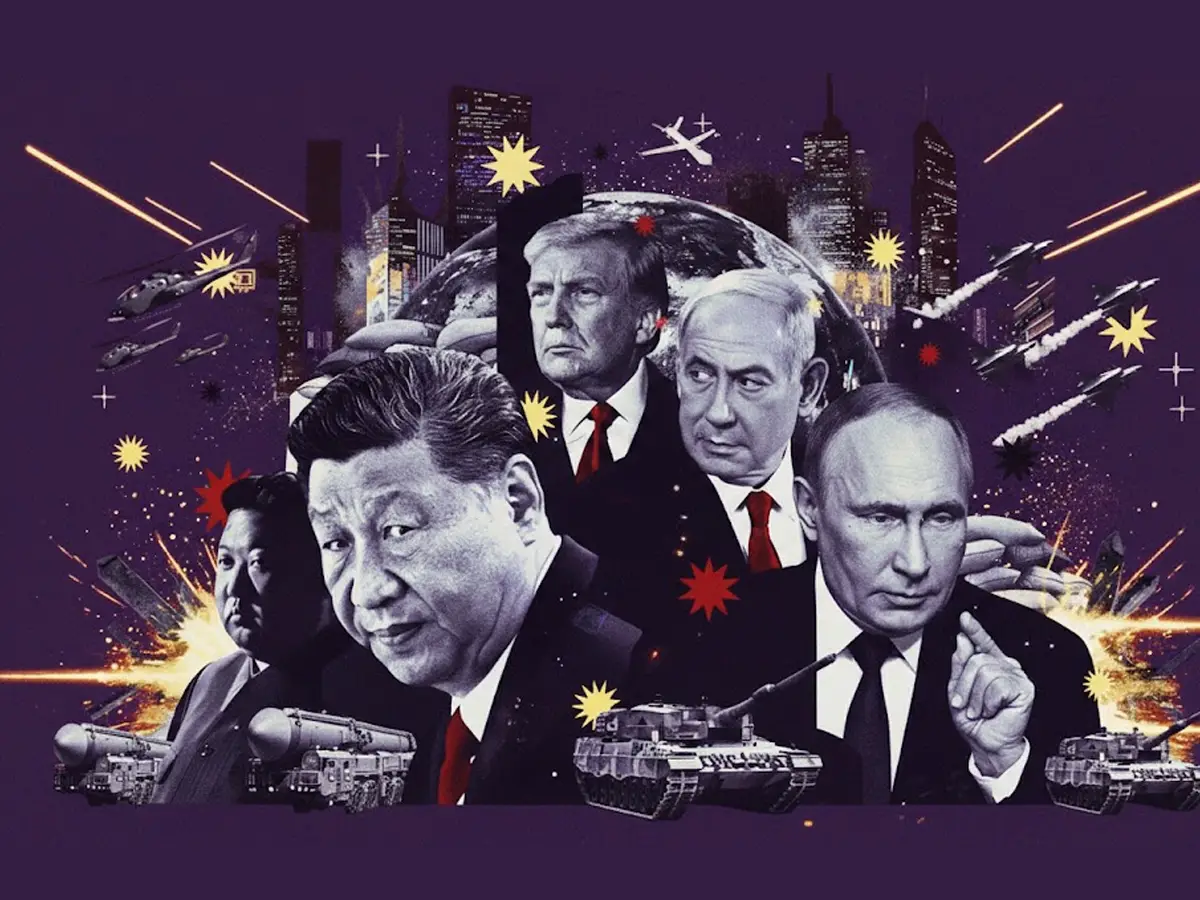
Every time I open the news, someone's screaming about World War 3. Iran's on the brink. Venezuela just got invaded. Ukraine keeps escalating. The headlines make it sound like nuclear war is right around the corner, and I get it—when you see a nuclear-armed empire in decline, it's natural to worry they'll burn everything down rather than accept losing their dominance. But here's what I've learned from watching how power actually works: World War 3 isn't coming. Not because everyone suddenly became peaceful, but because the people who run things switched business models, and nuclear war is terrible for business.
Let me explain what's actually happening instead.
The Power Structure Changed
For most of the second half of the 20th century, the dominant force in American power was what people call the Military-Industrial Complex. You've probably heard that term. It's the defense contractors—Lockheed Martin, Raytheon, Northrop Grumman—along with the Pentagon and the politicians they fund. Their business model was simple: profit from wars. Iraq, Afghanistan, Libya, Syria. Every conflict meant contracts for weapons, reconstruction, military bases, security services. The longer the war, the better the profits.
But something shifted over the last couple decades. The real power moved from the Military-Industrial Complex to what I call the Financial-Industrial Complex. This is a different group of players: BlackRock, Vanguard, JP Morgan, Goldman Sachs, State Street. These are the massive asset management firms and investment banks that control trillions of dollars. BlackRock alone manages over $10 trillion. Vanguard manages around $8 trillion. To put that in perspective, that's more than the GDP of every country on Earth except the United States and China.
These firms don't make money from bombs and invasions. They make money from debt, derivatives, asset control, and financial engineering. They own shares in almost every major corporation. They control the Federal Reserve—literally, the big banks are the Fed. Their executives rotate in and out of the Treasury Department and regulatory agencies. When someone leaves Goldman Sachs to become Treasury Secretary and then goes back to Wall Street afterward, that's not corruption in the traditional sense. That's just how the system works now. They are the system.
And here's the critical part: the Financial-Industrial Complex needs a functional global economy to extract wealth from. Nuclear war destroys wealth. It vaporizes assets, collapses markets, kills the customers and debtors they're extracting from. If you're managing $10 trillion in assets, the absolute last thing you want is a nuclear war that turns those assets into radioactive dust. So they won't let it happen.
What's Actually Happening
If you look at what's actually going on instead of what the headlines say, the pattern becomes pretty clear. Let me walk through three recent examples.
Iran. Everyone's been talking about the Iran crisis for years now. Escalating tensions, sanctions, threats of military strikes. But look at what actually happened. Iran's currency collapsed. The rial lost massive value, inflation hit 40%, and people couldn't afford basic goods. Then Iran quietly changed the leadership of their central bank. That's the real signal. A new central bank means they're willing to negotiate, willing to reform, willing to potentially rejoin the global financial system on terms the Financial-Industrial Complex finds acceptable.
This is a financial takeover, not a military one. Iran's also been selling weapons for Bitcoin to bypass dollar sanctions, which shows how desperate they are for hard currency. The financial pressure is working. There's no invasion needed because the currency war already won. Iran is being absorbed into the global financial system, not bombed into submission.
Venezuela. The United States just invaded Venezuela, captured Maduro, and announced they're taking control of the country's oil production. Venezuela has 303 billion barrels of proven oil reserves—the largest in the world. That's worth about $17 trillion at current prices. And you know what happened after the invasion? Chevron's stock jumped 6.4%. ExxonMobil went up 3%. Oil service companies like Halliburton and Schlumberger all jumped 5% or more.
There was no World War 3. There was a corporate asset grab. American oil companies are going to spend $100 billion to $180 billion rebuilding Venezuela's trashed infrastructure, and in exchange they get extraction contracts on the biggest oil reserves on the planet. The profits go to Wall Street. Venezuelans don't benefit. Americans don't benefit. But the stock market pumped, which is exactly the point.
Ukraine. The war in Ukraine keeps dragging on, and every few months there's a new round of "this is it, this is when it escalates to nuclear war." But it never does. Because what's actually happening is a prolonged negotiation over regional spheres of influence. Russia wants eastern Ukraine—Donbas, the land bridge to Crimea, a neutral buffer state that never joins NATO. The US wants to maintain influence in the western part and keep Europe dependent on American security guarantees.
This isn't escalating to World War 3. It's leverage. The longer it goes, the more each side extracts from the deal. Russia gets territory, the US gets continued European dependence and justification for NATO expansion, and the defense contractors get to sell weapons. Eventually there will be a deal, probably by 2027, and the map will be redrawn. No nuclear war required.
The pattern across all three is the same: financial pressure, asset grabs, regional carving. That's the multipolar transition. It's messy and it looks chaotic, but it's not spiraling into nuclear war.
The Theater Serves a Purpose
So why does it feel like we're always on the brink? Because the fear is useful.
When everyone thinks World War 3 is about to start, a few things happen that benefit the Financial-Industrial Complex. First, countries become more willing to accept unfavorable terms in negotiations because they're scared. If you think war is coming, you'll make concessions you wouldn't otherwise make. That's extraction leverage.
Second, investors move capital based on perceived war risk. Money flows out of "dangerous" regions and into "safe" assets. The people managing those flows—the big asset management firms—profit from the chaos. They know where the money's going before it gets there.
Third, stock markets actually go up during these crises because defense stocks pump and corporations position themselves to grab assets during the "reconstruction" phase. Look at what happened after the Venezuela news. The market didn't crash in fear of war. Defense and energy stocks rallied because everyone knows this means contracts and profits.
The chaos is real. People are dying in Ukraine. Venezuelans are suffering. Iranians are dealing with economic collapse. But the chaos is also controlled. It's theater designed to maximize extraction while the global order gets restructured. And World War 3 makes for great theater, even though it's never actually going to happen.
Why the FIC Won't Let Nuclear War Happen
There are a few structural reasons why the Financial-Industrial Complex won't allow World War 3, even if some people in the Military-Industrial Complex or nationalist politicians might want it.
First, they need buyers for American assets. As the US declines as a global empire, the plan is to sell assets to GCC sovereign wealth funds (Saudi Arabia, UAE, Qatar) and Chinese investors. They're buying US real estate, infrastructure, companies, debt. You can't sell assets to buyers if you just nuked them. The transition to a multipolar world requires those buyers to be alive and functional.
Second, a multipolar world creates more profit opportunities, not fewer. When the world was unipolar under US dominance, there was less arbitrage, less variation between regions. But in a multipolar world where the US controls one region, China controls another, and the GCC controls a third, you can profit from the differences between those regions. Moving capital, exploiting regulatory differences, arbitraging currency flows—all of that becomes more lucrative. Nuclear war collapses that system back to zero.
Third, the Financial-Industrial Complex already proved they control the politicians, not the other way around. When Trump got debanked—when JP Morgan Chase closed his campaign accounts—that sent a very clear message about who actually runs things. Presidents are employees. The nuclear codes might be in a briefcase that follows the president around, but the decision to actually use them requires buy-in from the system. And the system won't approve it because too much money is at stake.
The Military-Industrial Complex had its moment. They wanted war with Iran for years. Netanyahu's been pushing for it. But the FIC won. Iran's getting absorbed financially instead of invaded militarily. That tells you which business model is dominant now.
What the Multipolar Carving Looks Like
So if World War 3 isn't happening, what is? The world is being carved up into regional spheres of influence, and each major "crisis" you see is actually a negotiation over who gets what.
The US dollar is shrinking from a global reserve currency to a regional currency. It'll still dominate in the Americas, but its role in Asia, the Middle East, and parts of Europe is declining. That's not a collapse, it's a managed transition. The FIC is orchestrating it because they profit from the new structure.
Strategic ports and resources are being divided. US corporations get some (like Venezuela's oil). China gets some (ports in Africa and Southeast Asia, influence in Central Asia). The GCC gets some (investments in Europe and North America, energy dominance in the Middle East). Russia gets its sphere in Eastern Europe and Central Asia.
Each crisis is a piece of this negotiation. Venezuela isn't about democracy or humanitarian intervention—it's about locking down the Western Hemisphere's energy resources for US corporate control. Ukraine isn't about defending freedom—it's about Russia securing its regional buffer and the US maintaining European dependence. Taiwan, when that comes, will be about China securing its regional sphere in exchange for not interfering with US control in the Americas and Europe.
This is managed decline for the American empire. Not chaotic collapse. The FIC doesn't want chaos. They want an orderly transition where they profit from both the decline and the rise of the new regional powers. That requires keeping the system functional, which means no nuclear war.
By 2027, Remember Who Was Wrong
Here's my prediction: by the time we hit 2027, World War 3 will not have started. There will have been crises, conflicts, maybe even some new invasions or regional wars. But no nuclear escalation. No great power war between the US, Russia, and China. Just a steady carving of the world into multipolar regions with financial warfare, asset grabs, and negotiated deals.
When that turns out to be true, I want you to remember every influencer, pundit, and analyst who spent the last few years screaming that World War 3 was imminent. Ask yourself why they were so wrong. Were they genuinely mistaken about how power works? Or were they profiting from your fear?
The real risk isn't nuclear war. The real risk is being on the wrong side of the wealth transfer. If you don't understand that the chaos is controlled, you'll make decisions based on fear instead of reality. You'll stay in a declining region instead of positioning where the money's moving. You'll hold assets that get inflated away instead of moving to hard assets that hold value in a multipolar world. You'll listen to people telling you to panic instead of people explaining the actual structure of what's happening.
I'm not saying the world is safe or peaceful. I'm saying it's controlled chaos, and understanding that changes everything. The Financial-Industrial Complex replaced the Military-Industrial Complex. Their business model requires a functional global system. Nuclear war destroys that system. So they won't let it happen.
The chaos is real. But it's theater. And if you understand the theater, you can stop being terrified of World War 3 and start positioning for what's actually coming: a multipolar world where empires carve up regions, currencies realign, and wealth transfers from the declining empire to the rising powers. That's the game. World War 3 was never on the table.
