

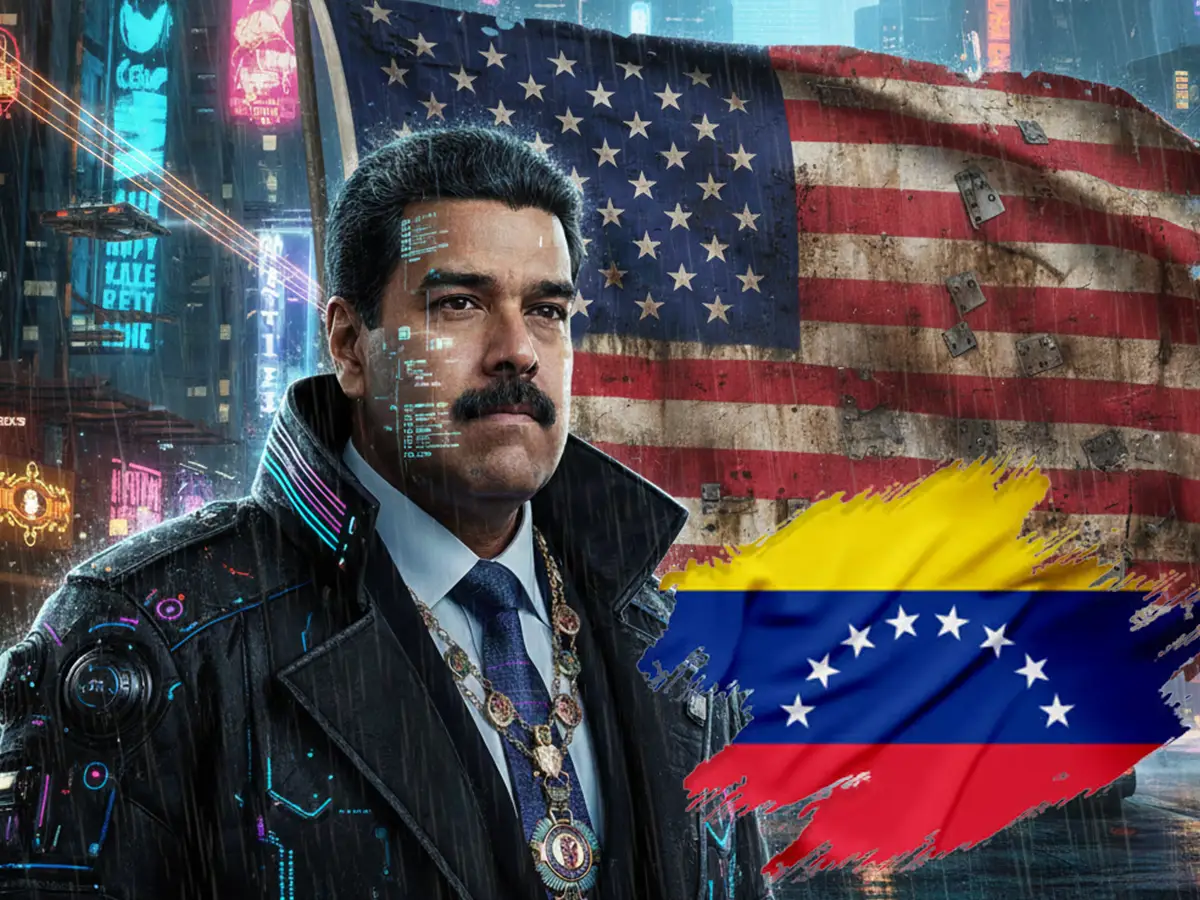
The United States just invaded Venezuela, captured Nicolás Maduro, and announced it's taking control of the country's oil production. The official story is that this is about restoring democracy and ending a humanitarian crisis. That's complete bullshit. This is about 303 billion barrels of oil—the largest proven reserves in the world—and if you understand what's happening with AI right now, the timing makes perfect sense.
Here's what nobody's saying out loud: America's tech industry is hitting a wall. AI data centers are consuming electricity at a rate that's breaking the power grid, and energy costs are making the entire AI infrastructure boom unsustainable. Venezuela's oil solves that problem. But there's a bigger story here that most people are missing. This isn't just a resource grab. It's a pre-negotiated empire deal where the US gets Venezuela's oil, Russia gets Ukraine, and China gets Taiwan. Let me explain how this actually works.
Why Venezuela's Oil Matters Right Now
Venezuela sits on more proven oil reserves than any country on Earth. We're talking 303 billion barrels—more than Saudi Arabia, more than Russia, more than anyone. Most of it is heavy crude concentrated in the Orinoco Belt, which is exactly what US refineries are designed to process. It's not the easiest oil to extract, but it's there, it's massive, and it's sitting in America's backyard where we can actually control it.
But here's the thing everyone's overlooking: the reason this is happening now, in 2026, has everything to do with what's going on in Virginia, Texas, and every other state where tech companies are trying to build AI data centers. Those facilities consume electricity like small cities. In Virginia alone, data centers are eating 26% of the entire state's power supply. The grid can't handle it. There's a seven-year waitlist just to connect new data centers to the power grid in some regions because the infrastructure literally cannot support the demand.
This creates a massive problem for the AI boom everyone's betting on. You can't run ChatGPT, Claude, or whatever Google's cooking up if you can't keep the servers powered. And you definitely can't scale AI to the level these companies are promising investors if energy prices stay high. The entire business model falls apart. Tech giants need energy costs to come down, and they need it fast. Venezuela's oil flooding the global market is how you make that happen.
The Long Game: Crashing Oil Prices
When Venezuela was producing at peak capacity in the late 1990s, they were pumping 3.5 million barrels per day. Under Chávez and then Maduro, combined with US sanctions, that collapsed to around 800,000 barrels per day—less than 1% of global production. The infrastructure is trashed. Skilled workers fled the country. It's a disaster.
But that's actually perfect for the US strategy. Because now American oil companies can go in, spend $100 billion to $180 billion over the next decade rebuilding everything, and ramp production back up to 3 million barrels per day or more. That's not a small amount of oil. When you add that much supply to global markets over time, it puts sustained downward pressure on prices.
This serves multiple interests at once. Lower oil prices hurt Russia and Iran economically—both of them depend heavily on oil revenue to fund their governments and militaries. It makes US domestic energy production more competitive because our producers can undercut OPEC. It reduces inflation by bringing down energy costs across the economy. And critically, it keeps the dollar as the global reserve currency because oil is still priced in dollars, and controlling a major new source of supply reinforces that system.
The markets are currently oversupplied by about 2 million barrels per day, so this isn't going to cause some immediate price crash tomorrow. But over the next 10 to 15 years as Venezuelan production scales back up under US control? That's a different story. That's long-term structural pressure on global oil prices, which is exactly what the AI infrastructure buildout needs to pencil out financially.
The Grand Bargain Nobody's Talking About
Here's where it gets interesting. If you just look at Venezuela in isolation, the "weaken Russia and Iran" narrative makes sense on the surface. But if you zoom out and look at what's happening with Ukraine at the exact same time, it stops making sense unless you understand how empire deals actually work.
Russia isn't stupid. They know what the US taking over Venezuela means for global oil markets. They know it threatens their revenue. So why aren't they doing more than issuing performative statements? Why is China, which has been Venezuela's biggest oil customer, staying relatively quiet? Because they got their compensation on the back end.
The deal is simple: US gets Venezuela, Russia gets Ukraine, China gets Taiwan. Or more specifically—Russia gets the parts of Ukraine that matter to them: Donbas, the land bridge to Crimea, a neutral buffer state that's never joining NATO. China gets a free hand in Taiwan without US military intervention. And the US gets 303 billion barrels of oil to power the AI boom and maintain dollar dominance.
This isn't speculation. Look at the timing. Trump's people have been openly talking about ending the Ukraine war quickly and being "realistic" about territorial concessions. The Venezuela intervention happens while those negotiations are ongoing. And if you've been paying attention to the shift in US rhetoric on Taiwan—less talk about defending it militarily, more emphasis on "strategic ambiguity"—you can see where this is headed. You think that's all coincidence?
This is how empire actually functions. These deals are pre-negotiated behind closed doors. The US, Russia, and China sit down and carve out their spheres of influence. You take Eastern Ukraine, you take Taiwan, we take Venezuela's oil. Everyone gets their strategic priority. Nobody actually threatens the other's core interests. Then they sell it to their domestic populations with completely different stories—democracy promotion on one side, reunification on another, defending Russian speakers on the third. It's all theater.
We've seen this before. Yalta Conference. Molotov-Ribbentrop Pact. The entire Cold War was built on this kind of sphere-of-influence bargaining. The only difference now is that social media makes it harder to keep the real deal quiet, but most people still aren't connecting the dots because the media coverage treats Ukraine, Taiwan, and Venezuela as completely separate stories. They're not. They're three parts of the same negotiation.
How We Got Here: Sanctions as Setup
None of this happens without the groundwork that was laid over the past two decades. Venezuela's oil production didn't collapse by accident. It was a combination of horrible domestic policy under Chávez and Maduro—nationalizing everything, driving out foreign expertise, zero investment in infrastructure—and then US sanctions that accelerated the death spiral.
By 2019, when the US hit Venezuela with full sanctions on their state oil company PDVSA, production was already down to about 1.5 million barrels per day. The sanctions cut that in half almost immediately. They couldn't access international markets, couldn't get financing, couldn't import the equipment and chemicals needed to process their heavy crude. Production bottomed out at around 337,000 barrels per day in 2020. The country was economically destroyed.
This created the perfect justification for intervention. You sanction a country until their economy collapses, which creates a humanitarian crisis, which becomes the moral justification for going in to "help" by taking control of their resources. We've seen this exact playbook in Iraq, Libya, and Syria. The only difference is that Venezuela's intervention is being sold as a rescue operation instead of a war, but the mechanics are identical. Destroy the country's ability to function independently, then step in to "rebuild" under terms that benefit US corporations.
This Was Never About Maduro or Democracy
Let's be very clear about something: the United States does not give a shit about democracy in Venezuela. We backed Pinochet in Chile. We supported death squads in El Salvador and Guatemala. We propped up Somoza in Nicaragua. The idea that we suddenly care about human rights in Caracas is laughable.
Saudi Arabia beheads dissidents and bombs Yemen into oblivion, and they're our close ally. We sell them weapons. If democracy and human rights actually drove our foreign policy, we wouldn't be doing arms deals with half the regimes we support.
The real issue with Venezuela wasn't Maduro being authoritarian. The real issue was that Venezuela was selling 81.7% of its oil exports to China and getting paid in yuan instead of dollars. That's the crime. Threatening the petrodollar system by conducting oil trade outside of US currency is what gets you on the regime change list. Libya's Gaddafi was talking about creating a gold-backed currency for African oil trade before NATO turned his country into a failed state. It's always about the dollar and resource control.
What Happens Next
In the short term, the US is already selling off the 30 to 50 million barrels of Venezuelan oil that was sitting in storage, waiting for sanctions to lift. That's immediate revenue and a quick market injection. But the real play is the 10 to 15 year rebuild.
American oil companies—Chevron, ExxonMobil, ConocoPhillips, all the majors—will get extraction contracts at terms that are extremely favorable to them. They'll spend somewhere between $100 billion and $180 billion rebuilding Venezuela's oil infrastructure, which sounds like a lot until you realize what they're getting access to. Once production is back up to 3 million barrels per day or higher, the revenue streams are enormous. And it's all flowing through US-controlled companies, priced in dollars, feeding into the system that keeps American financial dominance intact.
Meanwhile, the wealth doesn't stay in Venezuela. It never does. The pattern is always the same: foreign corporations extract resources, local populations see minimal benefit, and the profits get repatriated to New York and Houston. Venezuela's 303 billion barrels will enrich Wall Street and make AI infrastructure viable for Silicon Valley, but the average Venezuelan isn't going to see their life improve. They'll still be dealing with the aftermath of economic collapse while watching their national resources get shipped out under foreign management.
And the long-term oil supply increase puts sustained pressure on global prices, which is exactly what the AI boom needs to work economically. Lower energy costs mean data centers become profitable. Tech companies can scale without hitting the power grid wall. The entire AI infrastructure that's being built right now pencils out because oil is cheaper. That's the end game.
Why This Keeps Working
The reason we're able to pull this off repeatedly—Iraq, Libya, Syria, now Venezuela—is because the media frames every intervention as its own unique story. Each one gets sold as a humanitarian mission or a response to a specific crisis, and most people don't step back far enough to see the pattern. By the time it's obvious that it was always about resources, the contracts are signed, the infrastructure is under new management, and the oil is already flowing.
Right now, if you're reading mainstream coverage of Venezuela, you're getting stories about Maduro's corruption, the humanitarian crisis, the need for democratic restoration. You're not getting stories about AI data centers consuming 26% of Virginia's electricity or the grand bargain that gave Russia a free hand in Ukraine and China a free hand in Taiwan while the US took control of South America's oil. Those dots don't get connected in front-page news.
And here's the thing: most people don't want to believe their government operates this way. It's more comfortable to think we're the good guys spreading democracy than to accept that we're just another empire carving up the world for resources and strategic advantage. So the official narrative has staying power even when it doesn't make sense.
But if you pay attention to what's actually happening rather than what we're being told is happening, the logic is pretty straightforward. The AI industry needs cheaper energy to scale. Venezuela has the oil to make that happen. Russia and China need compensation to stay out of the way. Ukraine and Taiwan are that compensation. Everyone at the empire table gets their piece. The only people getting screwed are the ones who don't have a seat—which, as always, is everyone else.
That's the real story. Not democracy. Not humanitarian intervention. Just empires making deals and trading territories like chess pieces while the rest of us are supposed to believe it's about moral principles. Same as it ever was.
