


I don't hold Bitcoin through bear markets. I know that sounds like heresy to the "HODL forever" crowd, but here's the thing: I'm not trying to prove my loyalty to an asset. I'm trying to accumulate more of it. And the way I do that is by recognizing that Bitcoin moves in cycles—predictable, repeating patterns that have played out three times now with remarkable consistency. If you understand the structure and have the discipline to execute, you can turn your original investment into "free" Bitcoin over time. Here's how I've done it, with real numbers.
The Pattern Everyone Sees But Most People Ignore
Bitcoin has followed the same playbook since 2017. It's not complicated. The cycle goes like this: parabolic rise, violent crash, long boring accumulation, then explosive recovery. Repeat. The percentages change a bit each time, but the structure stays the same.
In the first cycle, Bitcoin peaked near $21,000 in late 2017, then crashed 84% down to around $3,000-$4,000 by late 2018. Everyone said it was dead. Then it wasn't.
In the second cycle, Bitcoin hit $69,000 in November 2021, then dropped 77% to the $15,000-$17,000 range by late 2022. Again, obituaries everywhere. Again, wrong.
Now we're in the third cycle. Bitcoin peaked at $126,000 in October 2025. As I'm writing this in February 2026, it's trading around $70,000—down about 45% from the top. And here's where it gets interesting: if the pattern holds, we're only halfway down. Historical cycles don't bottom at 45% drops. They bottom at 70-80% drops. That means we're looking at a target zone somewhere between $45,000 and $55,000, and my prediction is we'll see that happen between July and October of this year.
The structure is repeating. The question is whether you have the patience to wait for it.

The Strategy Is Simple, But Execution Is Hard
Here's what I do. I sell Bitcoin when everyone's euphoric and buying. I hold USDT or USDC in self-custody through the bear market. Then I buy back when everyone's panicking and convinced Bitcoin is finished. The result is that I end up owning more Bitcoin than I started with, using the exact same capital.
You don't need to time it perfectly. I've never sold at the exact top or bought at the exact bottom. That's not the point. The point is being in the right phase. If you sell 70-80% of the way up the mountain and buy back 70-80% of the way down, you still win by a lot.
Let me show you the actual math from the last two cycles, because this is where theory becomes real.
In November 2018, I bought Bitcoin at $3,500. I put in $10,000, which got me 2.86 BTC. I held through 2019 and 2020 while everyone said the bull market was over. Then in April 2021, when Bitcoin hit $60,000 and people were calling for $100K by summer, I sold. I didn't catch the $69,000 peak that came in November—I was 13% early. But I walked away with $171,600.
Bitcoin crashed. It went from $69,000 down to $15,500 by late 2022, a 77% drop. I sat in stablecoins and did nothing. No panic, no FOMO, just waited.
In January 2023, when Bitcoin was at $20,000 and everyone was still traumatized from the FTX collapse, I bought back in. Again, I missed the exact bottom at $15,500—I was about 29% late. But with my $171,600, I bought 8.58 BTC. I now owned three times more Bitcoin than I started with, and I hadn't added a single dollar of new capital.
That's the game. Sell in euphoria, buy in despair, and accumulate more Bitcoin each cycle.
Fast forward to October 2025. Bitcoin hit $126,000 and I sold at $125,000—basically caught the peak this time. That gave me $1,072,500 from my original $10,000 investment seven years earlier.
Now here's where the current cycle gets interesting. Let's say you took that $1,072,500 and bought Bitcoin today at $70,000 in February 2026. You'd get 15.32 BTC. But if you wait until the real bottom—my target zone of $45,000 sometime between July and October—you'd get 23.83 BTC with that same capital.
The difference between buying now and waiting six months is 55% more Bitcoin. That's not a rounding error. That's the difference between impatience and discipline.
Why Most People Get This Wrong
Right now, Bitcoin is down 45% from its peak. It feels bad. People who bought at $100,000 or $120,000 are sitting on big losses. Some of them are starting to panic. Others are trying to be "smart" and dollar-cost average their way back to breakeven.
But here's what I know from watching this play out twice before: we're not at the bottom yet. We're halfway down. The real capitulation—the moment when even the hardcore believers start to question whether Bitcoin has a future—that hasn't happened yet.
In late 2018, Bitcoin at $3,000 felt like the end of the world. In late 2022, Bitcoin at $15,000 felt like a scam that finally got exposed. Both times, that feeling of despair was the signal that the bottom was near. Right now, at $70,000, it doesn't feel good, but it doesn't feel catastrophic. That tells me we have further to go.
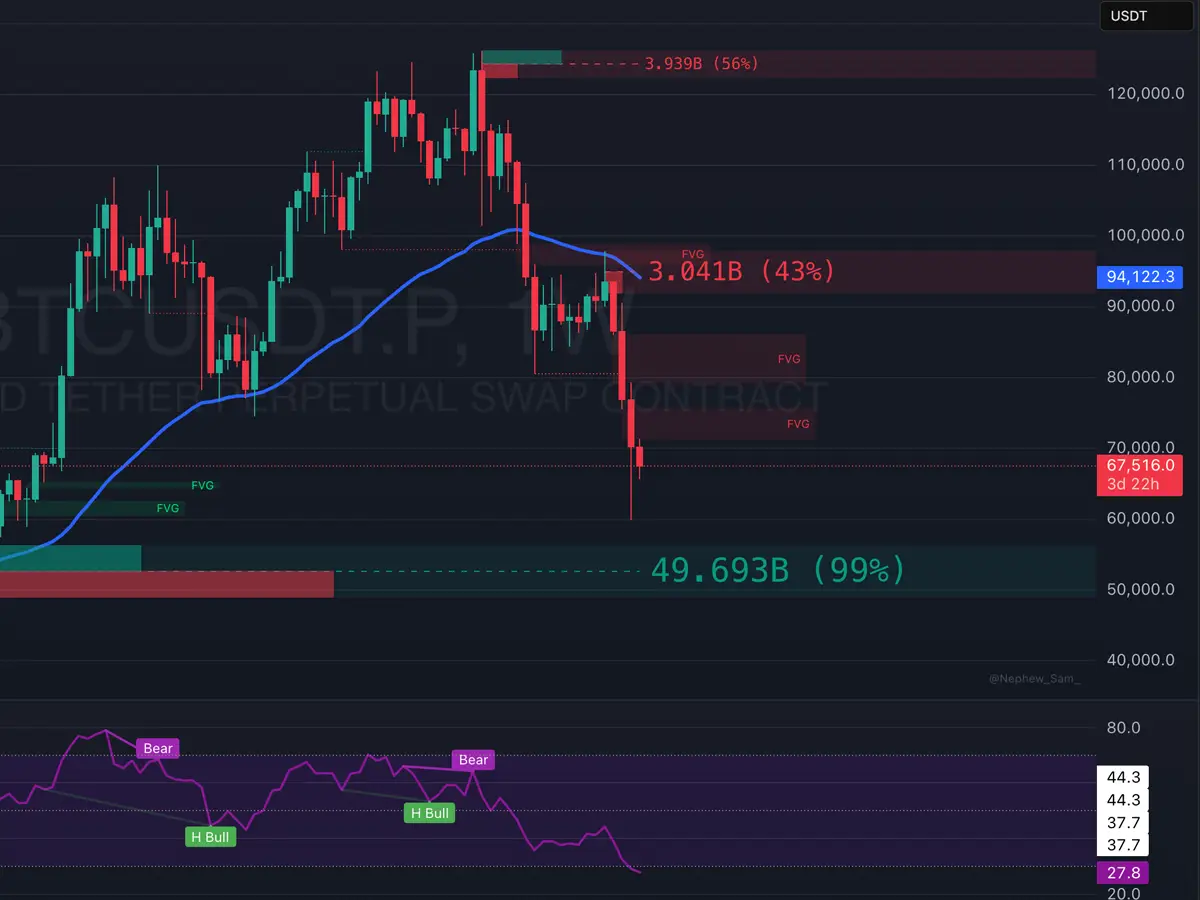
My prediction is that we'll see one more major leg down starting mid-year. July through October 2026 is when I expect the real panic. That's when Bitcoin will drop into the $45,000-$55,000 range, which would represent a 65-75% drawdown from the peak. That fits the historical pattern perfectly.
Will I catch the exact bottom? Probably not. I'll be early or late by 10-20%, just like every other time. But that's fine. The goal isn't perfection. The goal is being in the accumulation zone when prices are structurally cheap, not trying to buy today because you're scared of missing out.
What This Actually Means
I started with $10,000 in late 2018. Over the course of two full cycles, I've turned that into over $1 million by simply following the pattern: sell near peaks, hold stables through crashes, buy near bottoms. I didn't trade altcoins. I didn't try to get clever with leverage. I just recognized that Bitcoin moves in cycles and executed the strategy with discipline.
After those two cycles, my original $10,000 is "free." I've extracted it over 100 times over. Everything I have now is profit, and if I execute this third cycle the same way—waiting for the $45,000-$55,000 zone instead of buying at $70,000 today—I'll own nearly 24 Bitcoin by the end of the year. That's over eight times more than I started with, using the same capital.
The difference between me and the people who "HODL no matter what" is that I treat Bitcoin like an asset with predictable cycles, not like a religion. When Bitcoin crashes 70-80% from its peak, the HODLers sit there and take the pain because they believe suffering through drawdowns is a badge of honor. I sit in stablecoins and preserve my capital so I can buy more Bitcoin when it's cheaper.
When Bitcoin inevitably drops to $45,000 in the next six months and everyone's convinced the cycle is broken, I'll be buying with preserved capital. The HODLers will still be underwater from buying at $100,000, trying to convince themselves that "zoom out" makes the pain go away.
Here's the reality: most people can't execute this strategy. They'll buy at $70,000 because they're scared of missing the bottom. Then they'll watch it drop to $45,000, panic, and sell at a loss. Or they'll refuse to sell at peaks because they're convinced "this time is different" and the price will keep going up forever. Both of those mistakes cost you Bitcoin.
The pattern has repeated three times now with the same basic structure. Maybe this time really is different. Maybe institutional money and ETFs will prevent the traditional 70-80% drawdown. But I'm not betting on it. I'm betting on the pattern continuing, because betting against 15 years of history is a lot riskier than following it.
We're mid-crash right now, not at the bottom. If you have the patience to wait until July-October 2026 when Bitcoin is at $45,000-$55,000 and everyone thinks it's over, you'll accumulate 55% more Bitcoin than if you buy today. If you don't have that patience, you'll pay for it.
That's the difference between strategy and emotion. The cycles reward the patient and punish the impatient. I know which side I'm on.
